
Creating arrow edges using CSS

Before we start, we have to understand the concept behind  "border"

Basically, borders render like this:
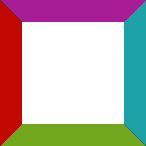
#sampleStyle{
   border-top   : 25px solid #a71d95;
   border-right : 25px solid #1da2a7;
   border-bottom: 25px solid #70a71d;
   border-left  : 25px solid #c10902;
   width :60px;
   heigth:60px;
}

If we compress the content area, i.e) make width and height values to "0px"

#sampleStyle{
     border-top   : 25px solid #a71d95;
     border-right : 25px solid #1da2a7;
     border-bottom: 25px solid #70a71d;
     border-left  : 25px solid #c10902;
     width :0px;
     heigth:0px;
}


If we want right arrow , make all border-color except border-left-color to transparent


#sampleStyle{
     border-top   : 25px solid #a71d95;
     border-right : 25px solid #1da2a7;
     border-bottom: 25px solid #70a71d;
     border-left  : 25px solid #c10902;
     width :0px;
     heigth:0px;
}


Example:
.arrow_box { 
  position: relative;
  background: #182126; 
  border: 1px solid #000000; 
  padding: 40px;
  width: 280px;
  height: 100px;
  border-radius: 6px;
  font-family:"Arial";
  font-size:46px;
} 

.arrow_box:after, .arrow_box:before { 
  top: 100%; 
  border: solid transparent; 
  content: " "; 
  height: 0; 
  width: 0; 
  position: absolute; 
  pointer-events: none;
} 

.arrow_box:after { 
  border-color: rgba(24, 33, 38, 0); 
  border-top-color: #182126; 
  border-width: 30px; 
  left: 50%; 
  margin-left: -30px; 
}

.arrow_box:before { 
  border-color: rgba(0, 0, 0, 0); 
  border-top-color: #000000; 
  border-width: 31px; 
  left: 50%; 
  margin-left: -31px; 
}
HTML
<div class="arrow_box">CSS ARROW EXAMPLE</div>

OUTPUT


Comments

Popular posts from this blog

Random Bouncing Ball Animation

Simple animation of random balls that bounces within the screen Source: #include<stdio.h> #include<graphics.h> #include<conio.h> #include<dos.h> #include<math.h> void drawBall(struct ball *b, int color); struct ball{ int x, y; int dx, dy; int radius; }; void main() { int gd=0, gm=VGAHI; int i; struct ball b[10]; initgraph(&gd, &gm, ""); for(i=1;i<=15;i++){ b[i].radius = rand()%20; b[i].x=rand()%getmaxx(); b[i].y=rand()%getmaxy(); b[i].dx=2; b[i].dy=4; } while(!kbhit()) { delay(5); cleardevice(); for(i=1;i<=15;i++) drawBall(&b[i],i); } closegraph(); } void drawBall(struct ball *b, int color){ setfillstyle(1,color); setcolor(color); fillellipse(b->x, b->y, b->radius, b->radius); if(b->x+b->radius > getmaxx() || b->x-b->radius<0) b->dx = -b->dx; if(b->y+b->radius > getmaxy() || b->y-b->radius<0) b->dy = -b->dy; b->x+=b-...

Simple Animation Using C

Here i have used fillpoly function to draw the object body and used fillellipse function to draw tier. animation is done by looping through the objects x & y position until user hits a key. Keypress event is achived  by using kbhit function. Smoothness of animation is controlled by delay function. Change the delay values to change the animation speed Source: #include<stdio.h> #include<conio.h> #include<graphics.h> #include<dos.h> void main() { int gd=DETECT,gm,i=-300,j; int poly[16]={100,100,250,100,250,50,300,50,325,90,325,140,100,140,100,100}; int tpoly[16]={100,100,250,100,250,50,300,50,325,90,325,140,100,140,100,100}; initgraph(&gd,&gm,""); getch(); while(!kbhit()) { for(j=0;j<16;j+=2) { poly[j]=tpoly[j]+i; } fillpoly(8,poly); setfillstyle(5,7); bar(275+i,60,295+i,85); setfillstyle(5,8); fillellipse(140+i,140,20,20); fillellipse(280+i,140,20,20); setfillstyle(1,0); fillellipse(140+i,140,10,10); fillellipse(280+i,140,10...

Things you may not know about CSS

Grammatical error like style using CSS: .grammar{ -moz-text-decoration-color: green; -moz-text-decoration-line: underline; -moz-text-decoration-style: wavy; text-decoration-color: green; text-decoration-line: underline; text-decoration-style: wavy; } Output : CSS 'empty-cells' Property table{ empty-cells:hide; }    CSS @supports  Usually we do CSS feature-test using JavaScript. Now it can be done in CSS with a new property '@supports' . So for Firefox 22+ , Chrome 28+, Opera 12.1+ supports this feature. So we can look forward to using it soon! Example: /* basic usage */ @supports(prop:value) { /* more styles */ } /* real usage */ @supports (display: flex) { div { display: flex; } } /* testing prefixes too */ @supports (display: -webkit-flex) or (display: -moz-flex) or (display: flex) { section { display: -webkit-flex; display: -moz-flex; display: f...